The "MVP" Trap: Why Most Minimum Viable Products Actually Fail
Building an MVP? Learn why 90% fail without proper foundation and how solid MVP development strategy prevents costly rebuilds. A survival guide for founders.
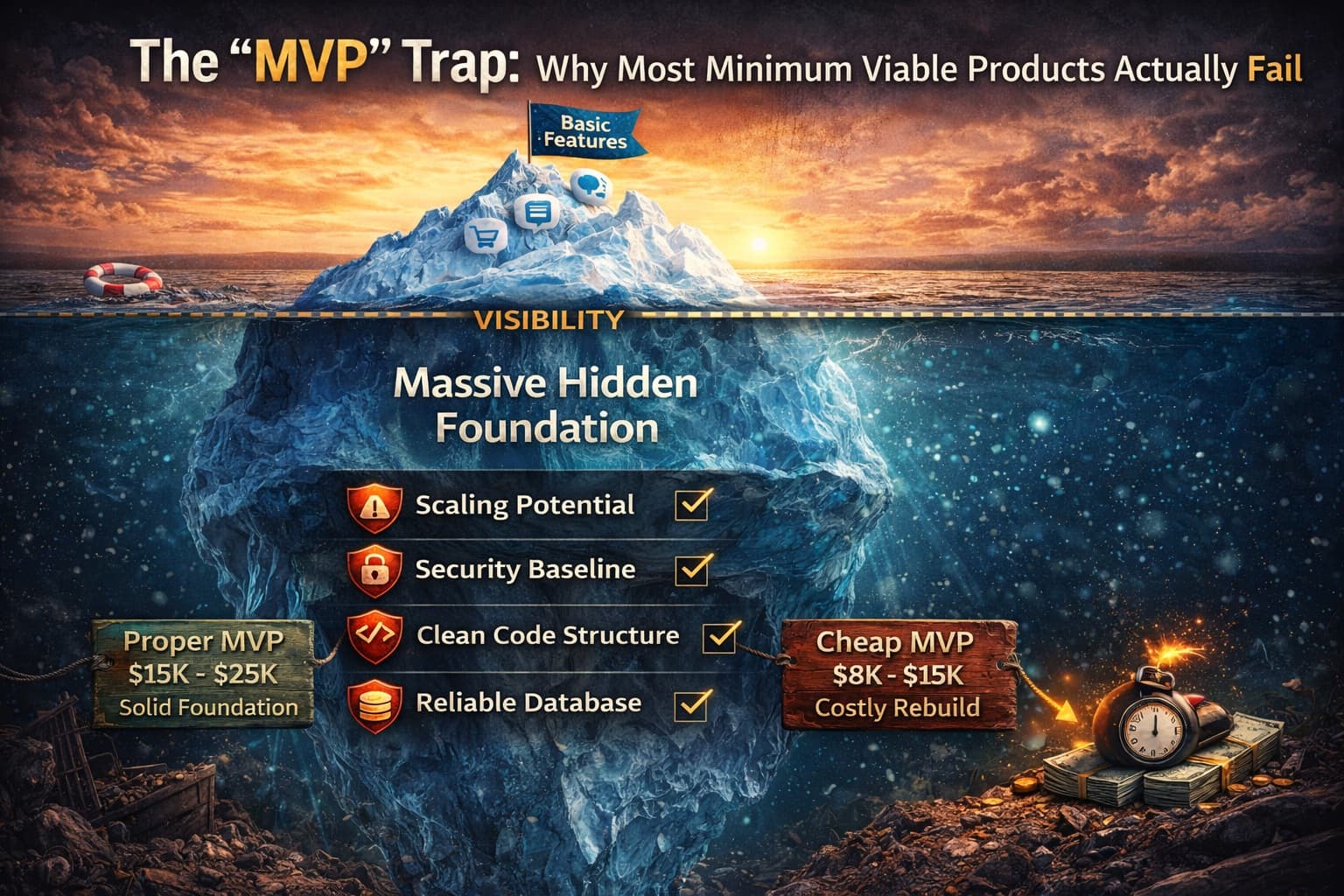
The "MVP" Trap: Why Most Minimum Viable Products Actually Fail
You launched your MVP in eight weeks. You cut every corner, skipped every "nice-to-have," and shipped something that was, honestly, pretty rough around the edges. But hey—that's what MVPs are for, right? Minimum. Viable. Product. You can fix it later once you have users.
Six months later, you have 2,000 paying customers. And your app is held together with digital duct tape.
Every new feature breaks three existing ones. Your "temporary" database is groaning under the load. The developer who built it has ghosted you, and the new guy says the only fix is a complete rebuild. For $40,000. While you lose customers every day your site is down.
Welcome to the MVP Trap. It’s way more common than you think.
Here’s the thing nobody tells you: An MVP isn't supposed to be a mess. It's supposed to be minimal—stripped down, focused, ruthlessly simple—but it's absolutely supposed to be built on a foundation that won't collapse when people actually show up.
Let’s talk about why most MVP development services get this wrong, how to spot the warning signs, and what "minimum but viable" actually looks like in 2026.
What "Viable" Actually Means (Spoiler: It's Not "Broken")
The term "Minimum Viable Product" got popular thanks to Eric Ries and the Lean Startup movement. The idea was beautiful: ship fast, learn fast, iterate based on real feedback instead of guessing in a conference room for six months.
But somewhere along the way, "minimum" became an excuse for sloppy. "Viable" got interpreted as "technically loads without crashing." And founders started treating their MVPs like paper airplanes—meant to fly once and be thrown away.
That’s expensive thinking.
"Viable" means your core value proposition actually works. If you're a ride-sharing app, the GPS has to pin the location accurately. If you're a meal delivery service, payments have to process reliably. If you're a coaching platform, video calls can't drop every five minutes.
These aren't "nice-to-haves." They're the entire reason your business exists. And if you build them poorly to save two weeks, you're not building an MVP. You're building a prototype that you're pretending is a product.
At Ark Services, we've seen too many founders confuse "speed" with "sloppy." The fastest path to market isn't the one with the most shortcuts—it's the one that doesn't require a complete do-over in month six.
The Three Myths That Kill MVPs
I've talked to hundreds of founders at this point, and I keep hearing the same dangerous assumptions. Let's destroy them right now.
Myth #1: "We'll just rebuild it once we have funding"
Sure. And I'll just diet once I finish this pizza.
Rebuilding sounds easy when you're staring at a blank spreadsheet and dreaming of Series A. But rebuilding with live users, existing data, and monthly revenue at risk? That's a high-wire act over a shark tank. Most companies never actually do it—they just keep patching the broken thing until it becomes unfixable.
Myth #2: "Our developers said we can refactor later"
Refactoring is developer-speak for "reorganizing code without changing what it does." It's necessary, healthy, and takes time. Time you won't have when you're scrambling to keep servers online.
If your MVP needs immediate refactoring to add basic features, it wasn't viable. It was a prototype wearing a product's clothes.
Myth #3: "Startups are supposed to be technical debt disasters"
There's a weird pride in startup culture around burning the midnight oil to fix preventable disasters. Like somehow your suffering validates your hustle. It doesn't. It just means you made expensive choices you'll be paying for in stress, lost sleep, and churned customers.
The Foundation You Can't Skip (Even in an MVP)
So what separates a solid MVP from a ticking time bomb? It comes down to three non-negotiables that have nothing to do with features and everything to do with architecture.
Clean Data Structure
Your database is the foundation of everything. Get this wrong, and you're building a skyscraper on sand. A good MVP uses a database design that can grow—proper relationships between tables, no duplicate data storage, clear naming conventions that won't confuse future developers.
We audited an MVP last year where user profiles, order history, and payment records were all stuffed into one giant table. It "worked" for the first 200 users. At 2,000, queries took 15 seconds. At 10,000, the site crashed twice daily. The "fix" required migrating data to a proper structure while users were actively making purchases. It was like performing heart surgery on someone running a marathon.
API-First Design
Even if you're only building a web app now, your MVP should be built with APIs that could support mobile apps later. This isn't future-proofing for the sake of it—it's recognizing that most successful products eventually need to be everywhere.
If your developer hard-coded everything into the web interface with no separation between frontend and backend, congratulations: You now own a website, not a product platform. Adding iOS later means rebuilding from scratch.
Security Baselines
I know, I know. Security isn't a feature users can see. But data breaches are definitely something users feel. Your MVP needs basic authentication (proper password hashing, not storing credit card numbers in plain text), HTTPS everywhere, and input validation so the first hacker who probes your site doesn't own your entire database.
One healthcare startup we worked with skipped "unnecessary" security to ship faster. They made headlines two months later—not the good kind. The PR damage killed their traction permanently.
Speed vs. Quality: The False Choice
Founders think they have to pick between launching fast and launching right. That's a lie perpetrated by developers who can't estimate properly or want to bill you twice.
Here's the truth: A well-architected MVP actually ships faster than a sloppy one.
Why? Because clean code is predictable code. When your foundation is solid, adding features is modular—plug and play. When it's spaghetti, every new feature requires untangling old messes first.
We recently built an MVP for a fintech startup in 10 weeks. Their previous developer quoted 16 weeks for the same feature set. The difference? We spent week one on architecture—database design, API contracts, component structure. They wanted to "just start building."
By week six, we were adding features daily. Their previous project was still fixing login bugs from week two. Speed comes from clarity, not from skipping steps.
Red Flags Your MVP is a Trap (Not a Product)
How do you know if you're walking into the MVP Trap? Look for these warning signs:
Your developer can't explain the architecture in simple terms
If they say "it's complicated" or drown you in jargon when you ask how data flows through the app, they probably don't understand it themselves. Or they're hiding something.
Every new feature requires "fixing" old features
This is the definition of technical debt. New work should extend the product, not repair it.
You're already talking about "the rewrite"
If rebuild conversations happen before you hit 1,000 users, your MVP was built to fail.
Your hosting costs are climbing faster than your user count
Inefficient architecture wastes server resources. Good code scales economically.
Adding basic functionality requires "restructuring the database"
Database migrations with live users are risky surgery. They shouldn't be needed for standard feature expansion.
If you're seeing these patterns, pause. You might be in the trap already. But it's not too late to escape.
How to Build an MVP That Lasts (Without Building Forever)
So what's the middle ground? How do you ship fast without shipping garbage?
Start with user stories, not feature lists
Don't build "a dashboard." Build "a way for users to see their order history in under 2 seconds." Specific, testable, focused. If it doesn't directly serve a user need, it doesn't ship in the MVP.
Invest in the "invisible" 20%
Spend 20% of your time and budget on architecture that nobody sees but everybody depends on. Database design. API structure. Security basics. This isn't wasted effort—it's the foundation that makes everything else possible.
Hire for product thinking, not just coding
The best MVP developers ask "why" before "how." They challenge features that don't serve the core value. They suggest simpler approaches you hadn't considered. If your developer just takes orders and codes, you've hired a typist, not a partner.
Plan for iteration, not replacement
Build knowing you'll change things, but not that you'll throw everything away. Modular code. Clear documentation. Separation of concerns. These let you pivot without replatforming.
At Ark Services, we specialize in MVPs that survive their own success. We've seen too many founders celebrate their launch only to panic three months later when growth breaks their product. Our approach treats the MVP as Chapter One of a longer story, not a disposable pilot episode.
The Real Cost of a Bad MVP
Let's talk money because that's what this comes down to.
A "cheap" MVP built poorly might cost $8,000-15,000. The rebuild you'll need within a year? $30,000-60,000. Plus the lost revenue from downtime. Plus the customers who churned because your app was flaky. Plus the opportunity cost of your team fighting fires instead of selling.
Or you could spend $15,000-25,000 upfront for solid MVP development services that scale with you. Add features instead of fixing foundations. Focus on growth instead of damage control.
The "expensive" option is actually cheaper. It's just a matter of when you pay—and whether you pay in dollars or in stress.
The Bottom Line
The MVP Trap isn't about being too ambitious. It's about being too short-sighted. It's choosing the path that feels fastest today but kills your momentum tomorrow.
Your minimum viable product should be a launching pad, not a liability. It should prove your concept without poisoning your future. It should get you to market quickly, yes—but also keep you there when the market actually shows up.
The founders who win aren't the ones who ship the fastest. They're the ones who ship something they can actually build on.
Are you building an MVP right now? Are you worried you've already fallen into the trap, or are you confident your foundation can handle real growth? Drop a comment—we'll give you an honest assessment of whether you're building a product or a time bomb. And if you want to talk about building it right the first time, you know where to find us.
Comments
Join the discussion
Related Posts

Static vs Dynamic Websites: Which One Is Right for Your Business?
Static vs dynamic websites—which should you choose? Discover the real costs, maintenance differences, and which option fits your business goals in 2026

Why Every Small Business in Lucknow Needs a Website in 2026
Discover why 78% of Lucknow businesses are going digital in 2026. Learn how a professional website builds trust, attracts local customers, and drives real revenue growth
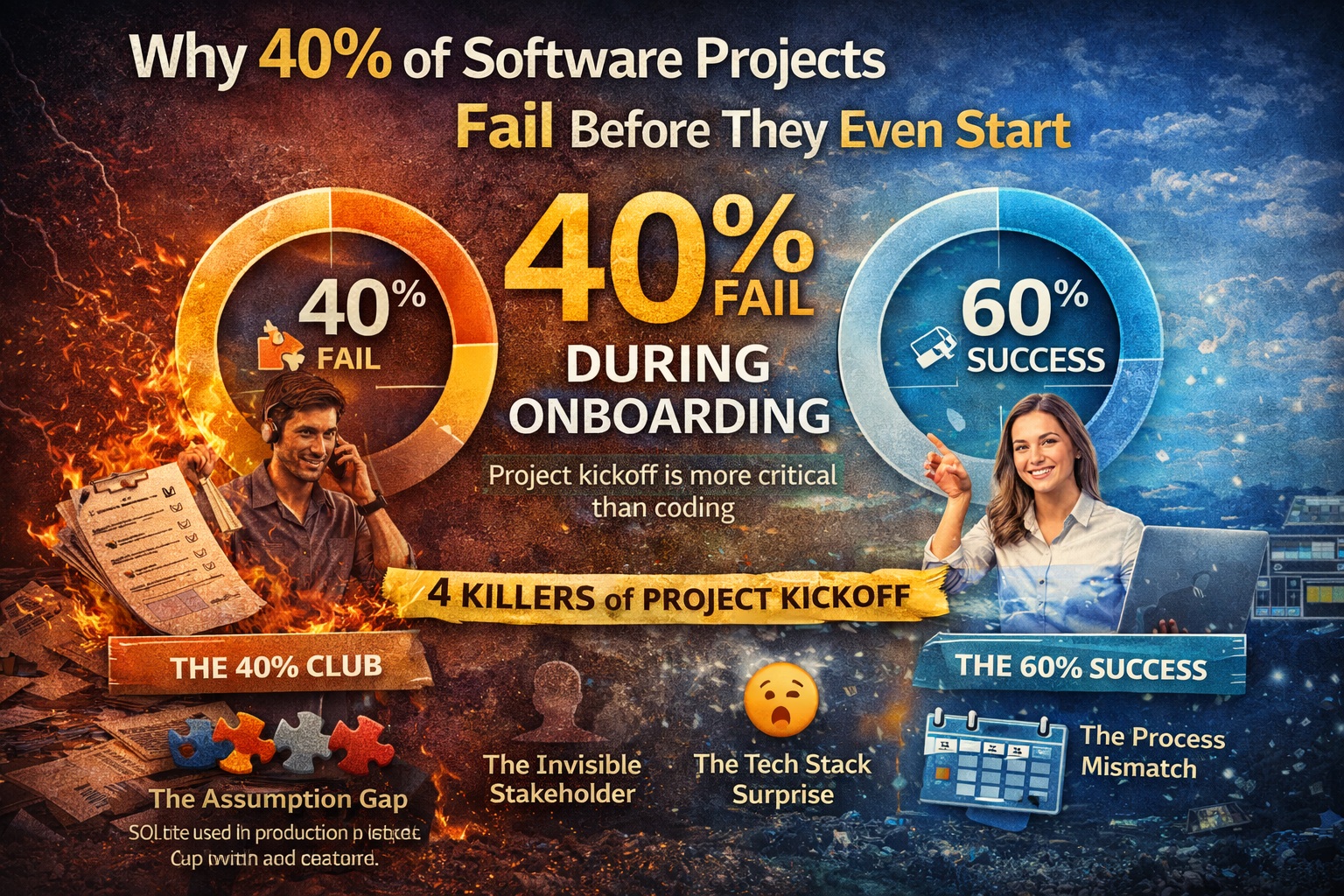
Why 40% of Software Projects Fail Before They Even Start
40% of software projects fail during onboarding. Learn why project kickoff matters more than coding and how to start your development project right.