Why 40% of Software Projects Fail Before They Even Start
40% of software projects fail during onboarding. Learn why project kickoff matters more than coding and how to start your development project right.
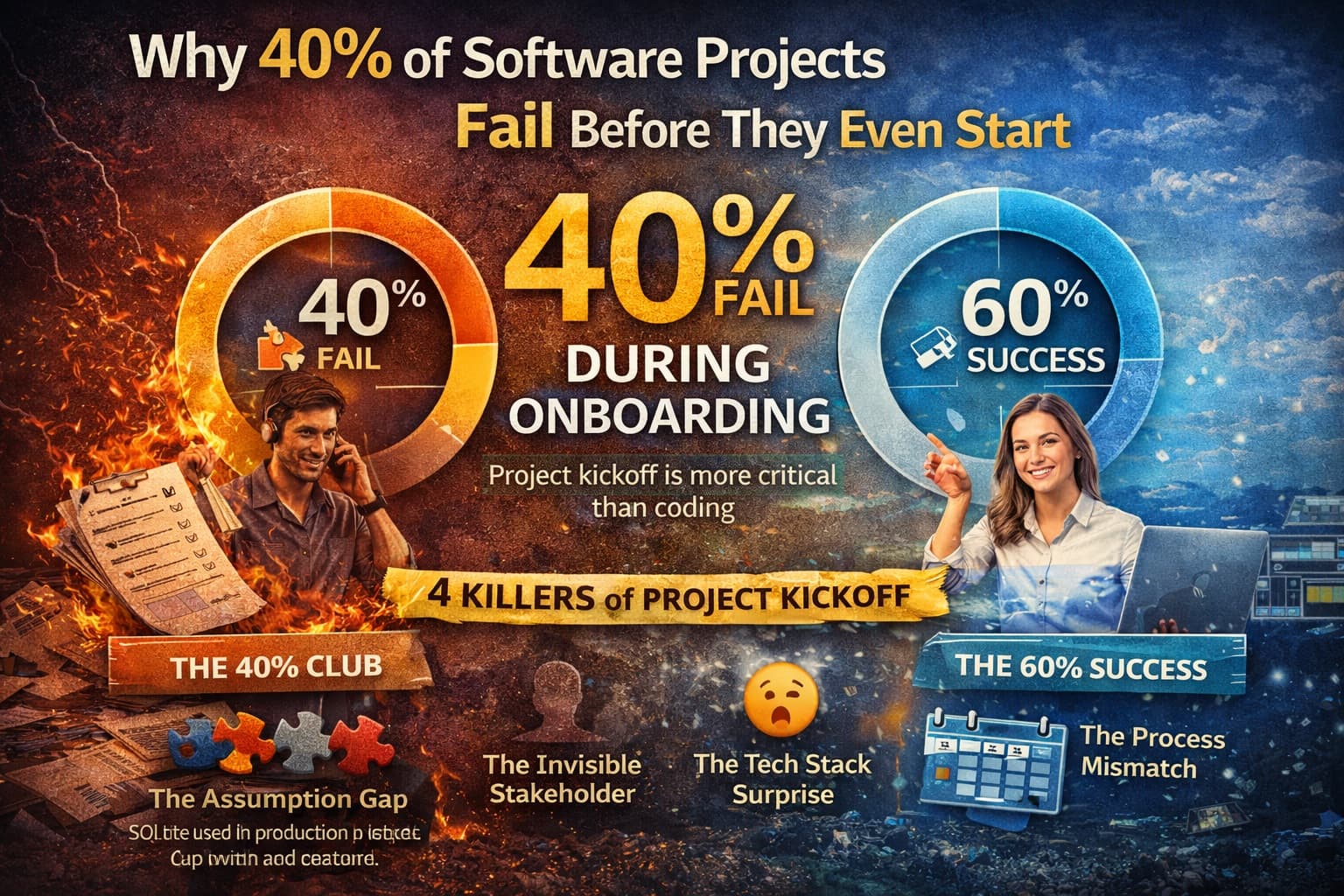
Why 40% of Software Projects Fail Before They Even Start
You've signed the contract. Paid the deposit. Your developer said "We're ready to rock!" and you felt that rush of finally getting started. This is happening. Your app is becoming real.
Three weeks later, you're staring at a mess. The "simple" feature you discussed somehow became "complex architecture requiring third-party integration." Your developer is asking questions you don't understand about "webhook endpoints" and "OAuth flows." The timeline just slipped by a month, and nobody can agree on what "user dashboard" actually means.
Congratulations. You've joined the 40%.
Here's the statistic that should terrify every founder: According to multiple industry studies, roughly 40% of software projects fail during the onboarding phase—that critical window between "we're hired" and "we're building." Not during coding. Not during testing. Right at the start, when everyone's supposedly aligned and excited.
At Ark Services, we've rescued projects that were doomed in week one. We've also learned that the best code in the world can't save a project that started with confusion, assumptions, and a handshake instead of a plan.
Let me show you why software project onboarding kills so many dreams—and exactly how to make sure yours isn't one of them.
The "Honeymoon Phase" Problem
There's something weirdly optimistic about project kickoffs. Everyone's excited. The developer is enthusiastic about your idea. You're thrilled to finally be moving. There's a shared Google Doc, a Slack channel with a clever name, and a sense that this time will be different.
And then reality hits.
That "simple" user authentication you described? Your developer interpreted it as "email and password." You meant "social login, two-factor auth, and biometric options for mobile." The "basic dashboard" in your mind had real-time analytics and export functions. Their "basic" mockup has three buttons and a chart.
Here's the thing: You can't build what you can't define. And most founders and developers skip the defining part because it feels like bureaucracy. It feels like wasting time when you could be "building."
But that skipped step? It's where 40% of projects die. Not from bad code—from bad communication dressed up as efficiency.
The Four Killers of Project Kickoff
After onboarding dozens of projects at Ark Services, we've seen the same failure patterns repeat. They look different on the surface, but they share the same DNA.
Killer #1: The Assumption Gap
You assume "user profile" means name, photo, and bio. Your developer assumes it means public/private settings, verification badges, activity history, and social sharing integration. You both say "yes" to the feature list, but you're building entirely different products.
The worst part? You don't discover the gap until the demo. When you see the "completed" feature and realize it's nothing like what you imagined. Cue the awkward conversation about "scope creep" and "misunderstood requirements."
Killer #2: The Invisible Stakeholder
Your developer builds exactly what you asked for. But you forgot to mention that your business partner needs admin access. Or that your compliance officer requires audit logs. Or that your marketing team needs to export user data for campaigns.
Suddenly "done" isn't done. And every new stakeholder who appears mid-project adds complexity, cost, and calendar time.
Killer #3: The Tech Stack Surprise
You assumed your app would work on iOS and Android because "everyone has phones." Your developer built a web app because "you didn't specify native." Or they chose a database that can't handle your projected user volume because "you didn't mention scale requirements."
Technical decisions made in week one determine what's possible in month six. If those decisions happen without your input—or without you understanding the implications—you're locked into constraints you never agreed to.
Killer #4: The Process Mismatch
You want weekly check-ins with demos. Your developer prefers "we'll show you when it's ready." You expect detailed time tracking. They work in broad milestones. You need daily standups; they find them disruptive.
These aren't personality conflicts. They're process failures that turn into resentment. By week four, you're micromanaging. They're hiding bad news until the last minute. The trust is broken, and the project is already off the rails.
What Proper Onboarding Actually Looks Like
So how do you avoid becoming a statistic? At Ark Services, we've developed a specific onboarding process that front-loads the hard conversations. It's not sexy. It doesn't feel like "building." But it prevents the disasters that kill projects later.
The Discovery Deep-Dive (Days 1-3)
Before we write a single line of code, we spend three days understanding your business. Not just your app—your business. Who are your users? What's your revenue model? What happens if this succeeds beyond your wildest dreams? What does "done" actually look like in six months?
We ask annoying questions. "What does 'user-friendly' mean specifically?" "What devices do your users actually use?" "What happens if someone tries to cheat the system?"
These questions feel tedious. They're actually gold. They surface assumptions before they become expensive misunderstandings.
The Technical Architecture Review (Day 4)
We show you exactly what we're planning to build and why. Database structure. API design. Third-party integrations. Security approach.
You don't need to understand the code. But you need to understand the implications. "This choice means we can launch faster but scaling will require a rebuild in year two." Or "This approach costs more upfront but handles 100,000 users without breaking."
Informed consent matters. You should know what you're buying, not just what you're getting.
The Stakeholder Map (Day 5)
Who needs to approve what? Who has veto power? Who's the final decision-maker when we disagree? Who else might need access to this system in six months?
We document it all. Because "I forgot to mention my co-founder needs to see this" in week eight is a project killer.
The Communication Contract (Day 6)
How often do we talk? What format? What constitutes "urgent" versus "can wait until the meeting"? Who responds to questions after hours?
This sounds like overkill. It's actually freedom. When everyone knows the rules, nobody has to guess. Nobody has to stress about "are they ignoring me or just busy?"
The Prototype Before the Product (Days 7-10)
We build clickable mockups—not functional code, but visual representations of every key screen. You click through. You feel the flow. You realize that "simple" checkout process actually needs six steps, not three.
Changing mockups takes hours. Changing code takes weeks. This is where we save projects from themselves.
Red Flags Your Onboarding is Failing
How do you know if your project is heading for the 40% graveyard? Watch for these warning signs:
Your developer starts coding immediately
If they're writing code in the first 48 hours, they haven't understood your problem. They're just building their interpretation of it.
You haven't met the actual team
If you're talking to a sales guy or project manager but have no idea who writes the code, you're not aligned. You're being managed.
There's no written record of decisions
"We agreed on that in the call" is a disaster waiting to happen. If it isn't documented, it didn't happen.
You feel stupid asking questions
Good developers explain things clearly. If you're feeling dumb for not understanding "webhook payload structure," that's a communication failure, not your fault.
The timeline feels arbitrary
"We'll have MVP in 8 weeks" without detailed breakdowns is hope, not planning. Hope doesn't ship software.
The Cost of Getting This Wrong
Let's talk money, because that's what this comes down to.
A "quick start" that skips proper onboarding might save you $2,000-3,000 upfront. But the rework when assumptions clash? That's $10,000-20,000 in changes. The delays from miscommunication? That's missed market opportunities, extended runway burn, and competitor advantages.
Worse, some projects never recover. The trust is broken. The developer quits or gets fired. You bring in a new team who has to reverse-engineer the mess before they can fix it. I've seen founders spend more on rescuing a bad start than they would have spent doing it right the first time.
At Ark Services, we charge for thorough onboarding. We make no apologies for it. Because we've seen the alternative, and it's way more expensive for everyone.
What You Can Do Right Now (Even If You've Already Started)
Already in motion? Not too late to course-correct.
Call a timeout
Tell your developer you want a "reset meeting." Review every assumption. Document every decision. Better to pause for a day now than lose a month later.
Demand visual prototypes
If you haven't seen clickable mockups of every major feature, ask for them. Insist on them. They're cheaper than code changes and reveal misunderstandings instantly.
Write down your "definition of done"
For every feature, describe what success looks like in specific, testable terms. Not "users can log in" but "users can log in with email/password, Google, or Apple, receive a confirmation email, and access their dashboard within 3 seconds."
Identify your real stakeholders
Who else needs to see this before launch? Get them involved now, not in week ten.
Establish communication rhythms
Suggest a specific schedule. "Let's do written updates every Tuesday and a video call every Friday." Clarity reduces anxiety for everyone.
The Bottom Line
Software projects don't fail because developers can't code. They fail because humans can't read minds. That 40% statistic isn't about technical incompetence—it's about communication breakdown dressed up as "getting started quickly."
The projects that succeed aren't the ones with the best developers. They're the ones with the clearest shared understanding before the first line of code is written.
Good onboarding feels slow. It feels bureaucratic. It feels like you're not "building" yet. But it's actually the foundation that lets you build fast and right later. Skip it, and you're building on sand.
Are you in the onboarding phase right now? Does your project have the clarity it needs, or are you hoping everything "just works out"? Drop a comment—we'll give you an honest assessment of whether you're set up for success or headed for the 40%. And if you want to start your next project with a foundation that lasts, you know where to find us.
Comments
Join the discussion
Related Posts

Static vs Dynamic Websites: Which One Is Right for Your Business?
Static vs dynamic websites—which should you choose? Discover the real costs, maintenance differences, and which option fits your business goals in 2026

Why Every Small Business in Lucknow Needs a Website in 2026
Discover why 78% of Lucknow businesses are going digital in 2026. Learn how a professional website builds trust, attracts local customers, and drives real revenue growth
The "MVP" Trap: Why Most Minimum Viable Products Actually Fail
Building an MVP? Learn why 90% fail without proper foundation and how solid MVP development strategy prevents costly rebuilds. A survival guide for founders.